*Apparently, knowing how to do the job isn't always enough anymore.*
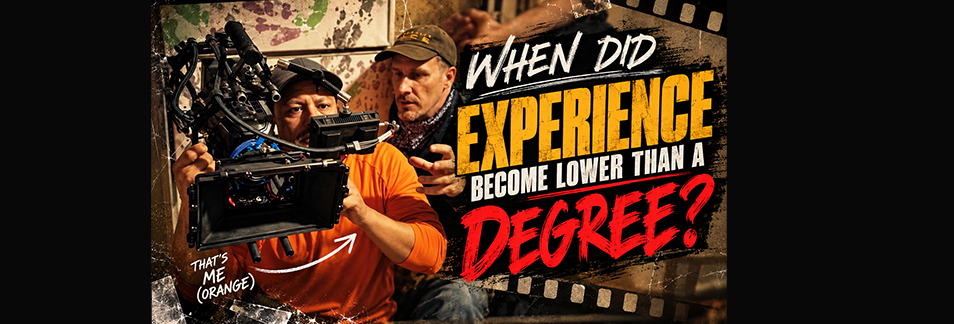
I remember working on movie sets years ago, and there was a running joke among the crew.
*What do you call someone who just graduated from film school?*
*A production assistant.*
Now, before anyone gets offended, it was a joke. Mostly.
The point wasn't that film school was worthless. It was that filmmaking was something you learned by actually making films. You could study lighting for four years, but eventually somebody was going to hand you a light and ask you to make it look like moonlight.
And the moon wasn't taking questions.
Back then, experience was everything. You learned by doing. By making mistakes. By solving problems at two in the morning when the location was closing, the director wanted one more shot, and somebody had misplaced the extension cords.
That was your education.
And believe me, there were tests.
## Somewhere Along the Way, the Rules Changed
Fast-forward a couple of decades, and something interesting has happened in the professional world.
You can have years of experience, manage projects, lead creative teams, produce successful campaigns, and build an entire portfolio of work.
But then you come across a job posting.
**Bachelor's degree required.**
Wait. What?
You mean the actual work I've done doesn't count unless I can produce a piece of paper saying I studied how to do it?
It's a little like telling a chef who's been running a successful restaurant for twenty years that he can't make you a sandwich because he didn't graduate from culinary school.
Sir, it's turkey and cheese.
## Don't Get Me Wrong. Education Matters.
I'm not against college. Far from it.
Education creates opportunities, builds foundations, and introduces people to ideas they might never encounter otherwise.
And some professions absolutely require formal education and credentials.
I'm just curious when experience started needing a permission slip.
Especially in creative industries, where your work is often right there for everyone to see.
Want to know if someone can edit video?
Watch their work.
Want to know if they understand storytelling?
Watch their work.
Want to know if they can produce a successful campaign?
Look at what they've produced.
Seems fairly straightforward.
But apparently, sometimes the first audience your portfolio has to impress is an application system looking for a checkbox.
And unfortunately, that system doesn't appreciate cinematography.
## The Funny Thing About Experience
Here's what I've discovered over the years.
Experience teaches you things that don't always fit neatly into a job description.
How to handle a client who changes direction halfway through production.
How to make a small budget look like a big one.
How to fix a problem nobody anticipated.
How to recognize when something isn't working before it becomes a disaster.
And perhaps most importantly, how to work with people.
You can learn the rules in a classroom.
But experience teaches you what to do when the rules stop working.
## So, What's the Answer?
I don't think it's experience versus education.
The strongest professionals often bring both, and there are incredibly talented people who have taken either path.
Maybe the real question is why we sometimes treat one path as proof of ability while making the other prove itself all over again.
A degree tells you someone completed an education.
Experience tells you what someone has actually done.
Both have value.
But neither should automatically erase the other.
And as for that old film-set joke?
Maybe the film school graduate still starts as a PA.
Maybe they don't.
The industry has certainly changed.
But one thing hasn't.
Eventually, somebody has to stop talking about how to make the movie...
And actually make the movie.
---
*JHector | Visual Storytelling*
*Still learning. Still creating. Still wondering who moved the goalposts.*