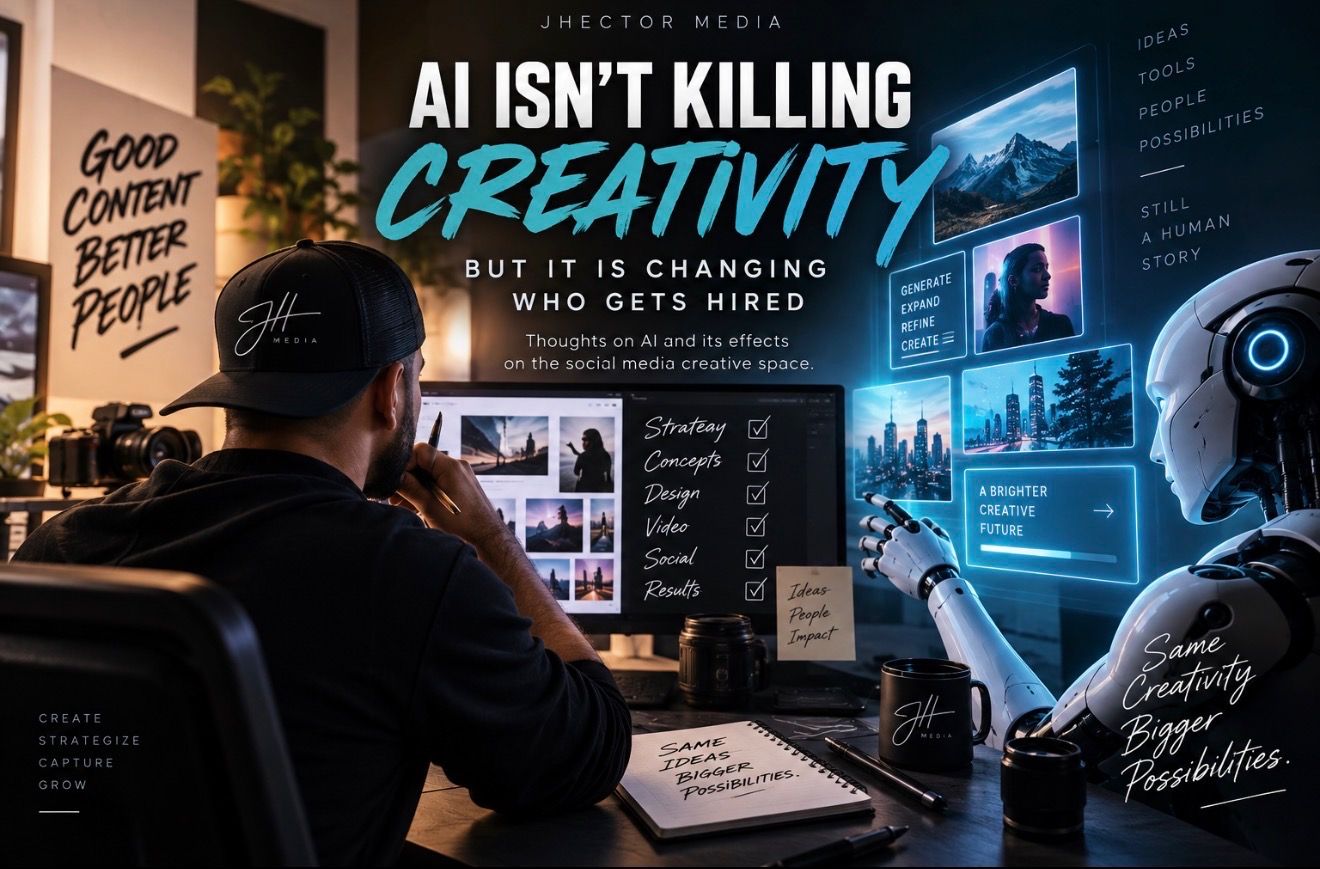
AI Isn’t Killing Creativity — But It Is Changing Who Gets Hired
If you work in marketing, graphic design, photography, video production, or social media, there’s probably been a moment recently when you’ve looked at what artificial intelligence can do and thought:
Well… this could get interesting.
AI can generate an image in seconds. It can write captions, create concepts, remove objects from photographs, generate video, build presentations, create voiceovers, and accomplish tasks that used to take a creative professional hours.
So the obvious question is: Are graphic designers, videographers, photographers, and content creators eventually going to be replaced?
I don’t think the answer is yes.
But I also don’t think we should pretend nothing is changing.
AI Is Already Changing Creative Work
The biggest mistake creatives can make right now is treating AI like something that’s coming in the future.
It’s already here.
Adobe’s 2026 Creators’ Toolkit Report found that 75% of creators surveyed who use or have tried creative AI consider it integrated into or essential to their workflow. Even more interesting, 93% said AI helps them produce content faster. (Adobe Newsroom (https://news.adobe.com/news/2026/06/creators-toolkit-report-2026?utm_source=chatgpt.com))
That’s a massive shift.
AI isn’t just another piece of software anymore. It’s becoming part of the creative workflow.
I use AI myself, and I’ve learned something important from doing it:
AI is incredibly good at helping you get somewhere faster. It isn’t necessarily good at deciding where you should go.
That’s a huge distinction.
The Button Pusher May Be in Trouble
Here’s where I think creatives need to be realistic.
If your entire value as a graphic designer is knowing how to operate Photoshop, Illustrator, or another piece of software, AI should concern you.
The same applies to video editors, photographers, copywriters, and social media creators.
Technical ability used to create a significant barrier to entry.
Today, someone with very little design experience can describe an idea and receive something surprisingly polished within seconds.
That means simply knowing the software isn’t enough anymore.
But knowing why something should look a certain way is different.
Understanding composition.
Knowing what image will stop someone scrolling.
Understanding a company’s audience.
Knowing when a video needs another two seconds before the cut.
Recognizing when something looks technically impressive but emotionally empty.
Understanding a client’s personality and translating that into a visual identity.
Those aren’t buttons.
Those are decisions.
And that’s where experienced creatives still have tremendous value.
We’re About to Have a LOT More Content
AI has dramatically lowered the barrier to creating content.
That’s good.
It’s also creating another problem.
We’re producing an unbelievable amount of stuff.
Graphics. Videos. Captions. Ads. AI avatars. AI voices. AI photographs.
And eventually audiences start recognizing when content feels manufactured.
Canva’s 2026 research found that seven out of ten consumers surveyed felt AI-generated advertising was missing something. At the same time, 87% of marketers surveyed said the best advertising still requires a human touch. (Canva (https://www.canva.com/newsroom/news/marketing-ai-report-2026/?utm_source=chatgpt.com))
That tells me something important.
The future probably isn’t human versus AI.
It’s human + AI versus mediocre content.
Will Graphic Designers Still Be Needed?
Yes.
But I think the definition of a graphic designer is going to change.
There’s legitimate reason for concern. The World Economic Forum’s Future of Jobs Report 2025 placed graphic designers just outside the ten fastest-declining roles, noting the increasing ability of generative AI to perform knowledge work. (World Economic Forum (https://www.weforum.org/publications/the-future-of-jobs-report-2025/in-full/2-jobs-outlook/?utm_source=chatgpt.com))
But that’s not the entire story.
Adobe studied U.S. creative job postings and found that creative-professional postings actually increased 8% between September 2025 and April 2026. At the same time, the percentage explicitly requesting AI skills increased from 10% to 15%. (Adobe (https://www.adobe.com/ai/research/202606/ai-is-redistributing-creative-work.html?utm_source=chatgpt.com))
That’s fascinating because it suggests something different from simply replacing creatives.
The job itself is changing.
Tomorrow’s designer might create the original concept, use AI to generate variations, bring those assets into Photoshop, correct the problems, establish brand consistency, build the campaign, and oversee how everything works together.
The tool changes.
The need for creative direction doesn’t disappear.
AI Can Give Small Creative Teams Superpowers
This might actually be the part of AI that excites me most.
A freelancer or small creative company can suddenly do things that previously required a much larger team.
You can brainstorm twenty campaign ideas before breakfast.
Generate storyboards before a shoot.
Test visual concepts before spending money producing them.
Create rough scripts.
Build shot lists.
Research audiences.
Repurpose one video into multiple pieces of social content.
Develop variations of graphics.
And then spend more of your actual time doing the thing AI still struggles with:
making the work mean something.
Adobe’s 2026 creator research found that 58% of creators surveyed said AI made them feel better able to compete with larger teams or studios. (Adobe Newsroom (https://news.adobe.com/news/2026/06/creators-toolkit-report-2026?utm_source=chatgpt.com))
For independent creators and smaller agencies, that’s potentially huge.
But There’s a Catch
AI makes average content incredibly easy to produce.
And that’s exactly why average isn’t going to be enough anymore.
When everyone has access to similar technology, access to the technology stops being the advantage.
Taste becomes the advantage.
Ideas become the advantage.
Experience becomes the advantage.
Storytelling becomes the advantage.
Knowing your audience becomes the advantage.
Having something worth saying becomes the advantage.
AI can generate a hundred ideas.
A creative professional still has to recognize the one worth making.
So, Am I Worried About AI?
A little.
I think every creative should be.
Ignoring a technology capable of fundamentally changing your profession would be foolish.
But I’m much more interested in learning how to use it than running from it.
I don’t believe AI will eliminate creativity.
I believe it will eliminate some creative tasks, dramatically speed up others, create entirely new ones, and force creative professionals to become better thinkers instead of simply better software operators.
The creatives who refuse to adapt could have a difficult road ahead.
The creatives who use AI as a shortcut for everything probably won’t produce anything particularly memorable either.
But the people who understand storytelling, branding, emotion, design, strategy and learn how to use AI?
Those are the creatives I’d bet on.
Because the future of creativity probably isn’t artificial intelligence.
It’s human creativity amplified by artificial intelligence.
And personally, I’m pretty excited to see what we create with it.